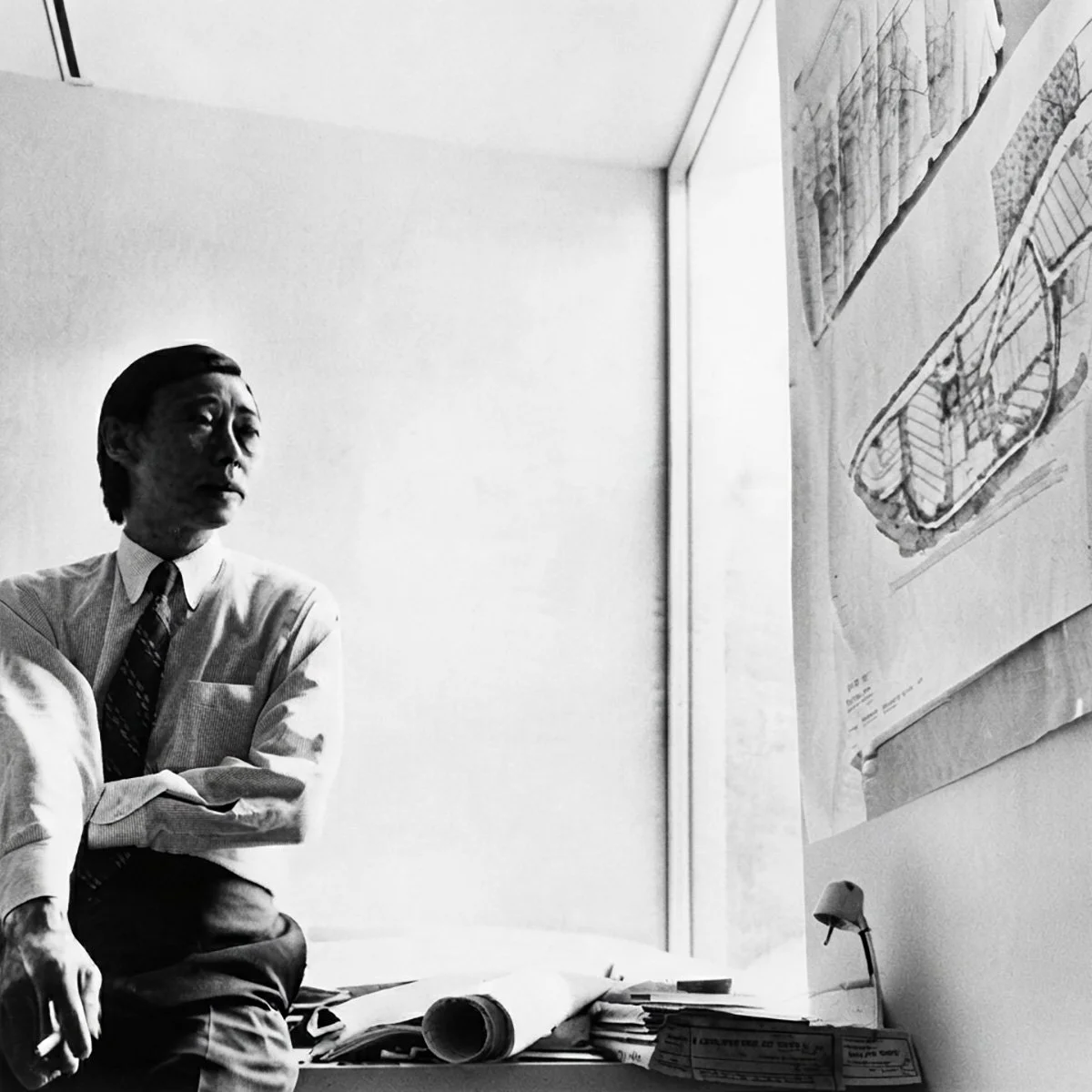
Francis Mah (1928–1998) was a Memphis architect who helped bring Modernism to a city better known for its traditional architecture. Trained at Yale under Louis Kahn, he designed houses, synagogues, banks, and hospitals across the South and beyond — and spent the last years of his career teaching design at the University of Memphis, because, as he put it, "it's time to give something back."
He believed buildings should belong to their place, that their systems should shape their form, and that architecture should be "honest, delight in the unexpected, and be void of any premeditated images."
"With its simplicity, these forms will become one of many nameless buildings, so necessary to cities because they form the background which frames the magnificent boulevards of Paris, or to give character to 5th Avenue in New York City, or to provide the ambience of the city of San Francisco."
— Francis Mah, 1977 presentation to the Memphis chapter of the AIA
Biography
Francis Mah was born in Honolulu, Hawaii, on June 5, 1928 — back when Hawaii was still a territory, not a state. His father, Quon Sung "Sunny" Mah, worked at Pearl Harbor and had to stop working after a head injury. His mother, Elsie Kam Lui Mah, worked as a seamstress and a waitress to help support the family. She encouraged him to pursue an education, but she died of breast cancer in 1951, while he was studying at Yale, and never saw him graduate.
Mah attended Maryknoll School in Honolulu, a Catholic secondary school, on a scholarship. Known as "Hunga" and "Southpaw," he was class vice president and a member of the Glee Club, Library Club, Sports Club, and Student Council. He played basketball, football, baseball, and track, and often went swimming. On December 7, 1941, he watched the attack on Pearl Harbor from the roof of his family's home. His class was the school's first to graduate after the end of World War II.
Mah enrolled at the University of Hawaii in 1946 on an AIA scholarship, then transferred to Yale, where he received a scholarship and a Bachelor of Architecture in 1952. He arrived with $500, intending to stay only as long as the money lasted. However, the university gave him a job in the library so he could remain. He went on to study under Louis Kahn and win the university's design competition.
After graduating, he spent six months at the Memphis firm of A. L. Aydelott before being drafted into the U.S. Army, serving two years in the Korean War. After his discharge he returned briefly to Hawaii, then went back to Memphis when Aydelott sent him a one-way ticket. He worked at the firm of Robert T. Martin, where he met Jeanine Edwards. They married on March 7, 1958, at a time when interracial marriages were uncommon. The couple found community among Memphis's Jewish, arts, and civil rights circles. Both were artists in their own right: he was the architect, and she was a writer, artist, seamstress, and gourmet cook.
Mah joined the office of Walk C. Jones Jr. in 1958. He became a partner in 1963 and the firm's designing partner in 1964. In 1966 the practice was renamed Walk Jones–Mah & Jones Architects, Inc. By the late 1960s he had moved from project designer to the firm's central design leader. He served as president of the Memphis chapter of the American Institute of Architects in 1970.
In 1971 the firm became Walk Jones & Francis Mah, Inc., with Mah as executive vice president. By 1974 it ranked 427th in dollar volume among Engineering News-Record's Top 500 design firms nationwide.
The 1970s brought major commissions — the Massachusetts Eye and Ear Infirmary expansion in Boston, the Hyatt Regency Memphis, Baptist Memorial Hospital East. In 1971, the Mah-LeMessurier precast concrete module system was first used at Luther Towers in Memphis; he was the inventor of record on U.S. Patent 3,882,649, issued in 1975. In the mid-1980s he worked with Martin E. Gorman Jr. on the U.S. Postal Service's computerized "Kit of Parts."
On January 1, 1986, Walk Jones & Francis Mah merged with Yeates-Gaskill-Rhodes Architects to form Jones Mah Gaskill Rhodes Architects — JMGR — with Mah as executive vice president. In 1987 he designed the firm's offices at Brinkley Plaza in downtown Memphis. He retired from full-time work four years later and established an independent practice.
In January 1991 he joined the faculty of Memphis State University as an assistant professor in the architectural technology program, teaching three lecture courses and a design laboratory each week. He also taught at Mississippi State University. Teaching, he said, was a way of giving back: "You get to a certain age, a certain point in your career and it's time to give back something. This is my way of giving something back."
Throughout their marriage, the Mahs traveled extensively — Europe, Asia, South America, Central America, Africa, and Australia. His wife shared: "Places were exciting to him only if architecture was there." Also a photographer, Mah reserved his camera exclusively for buildings. His collection of architectural slides from their travels is now housed in the Memphis Public Library Archives.